A 21st Century Clavichord:
Exploring Clavichords as Precedent Studies for the Design of a Modern Portable Keyboard Instrument
Introduction
Keyboard instruments have existed in many forms since at least the 3rd century BC, when the hydraulis was invented in Alexandria. In current times, the piano overwhelmingly dominates the keyboard market (Music Trades, 2018). As of 2018, Music Trades’ report on instrument sales’ only categories for non-digital keyboards are pianos and organs, which is a marked decrease in the diversity of keyboards compared to past centuries. This is due to both the broad stylistic range of the piano, as well as its suitability for mass-production. Modern technological advancement of keyboards has primarily focused on the piano. In contemporary keyboard development, the desire for increased performance volumes, practice-appropriate volumes, customizable tones, portability, and modern design aesthetics have all been met through the reworking of this single instrument. Some key modern user needs include portability and undisruptive practice capabilities. A number of historical instruments such as the clavichord, virginal, and portative organ are obvious precedents for these challenges, as they addressed these needs successfully in their time. The best modern solution is the digital piano, which uses the standard acoustic piano as a design precedent. My capstone project will explore the development of a portable modern keyboard instrument using non-piano keyboard instruments as precedents.
Background
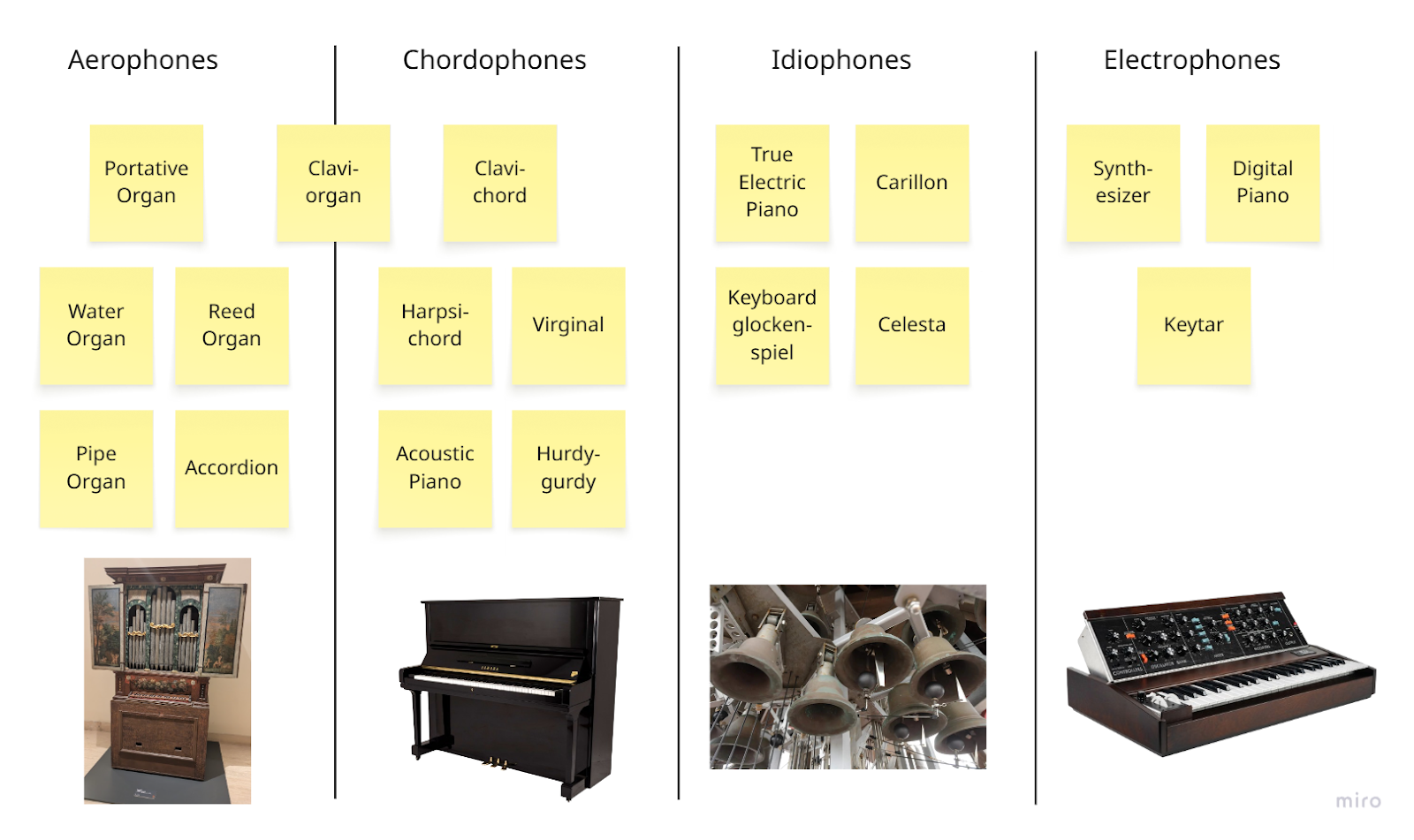
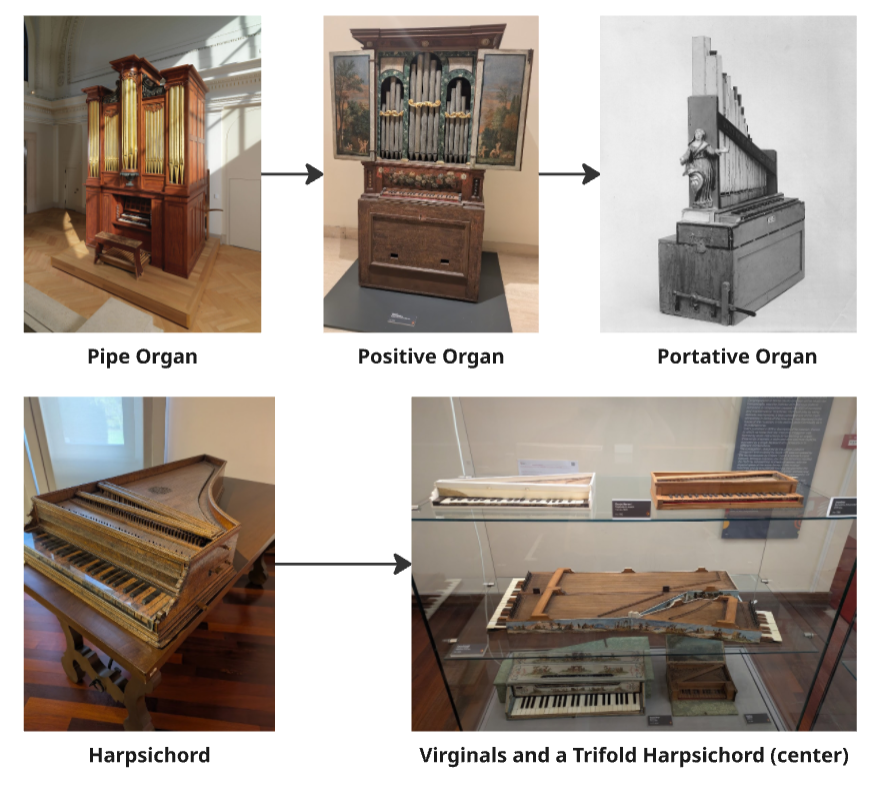
Keyboard instruments fall into four main categories: chordophones (sound produced by vibrating strings), aerophones (sound produced by a vibrating air body), idiophones (sound produced by the vibration of the instrument itself – in the context of keyboards, this is typically a vibrating ‘tongue,’ or a sort of bell), and electrophones (sound produced electronically). Figure A shows examples of instruments in each category. In addition to the large variety of available instruments, smaller and portable keyboards were also commonplace in antiquity. For example, the pipe organ is an aerophone that can be incredibly large (the Boardwalk Hall Auditorium Organ weighs 150 tons (Smith 2002)). However, a variety of smaller forms exist, the smallest of which is the portative organ [Figure B]. These were popular late medieval and renaissance instruments (Pittaway 2018). The harpsichord is a plucked chordophone that was popular in the renaissance and baroque periods. The standard version of these instruments was similar in form to, but slightly smaller than the modern grand piano. Smaller, and even folding variations of this instrument also existed [Figure B]. The virginal was a variant of the harpsichord, differentiated by the angle of the strings to the keyboard, which allowed it to be built incredibly small. The clavichord, a struck chordophone, was commonly used from the late middle ages into the baroque and classical periods. While there was no smaller version of the clavichord, the instruments were generally quite small. The initial usage of clavichords was most likely for teaching vocals and other instruments, but the instrument did become popular in its own right. Its benefits included “stability of tuning and mechanism… low cost and portability, and, very likely, the softness of its tone – so low that one can play it without disturbing others nearby” (Koster, Kirk, and Germann 1994, xiv).
Action Studies – Background Research
Keyboard chordophones are any instruments in the keyboard family that produce sound through the vibration of strings. [Chordophones, as an overarching category also includes non-keyboard instruments such as the violin and guitar, but in the context of this paper will refer to the subcategory of keyboard instrument unless otherwise noted.] Chordophones can be further classified by the method in which the string is vibrated. They can be plucked, struck, or bowed, with the vast majority either being plucked or struck.
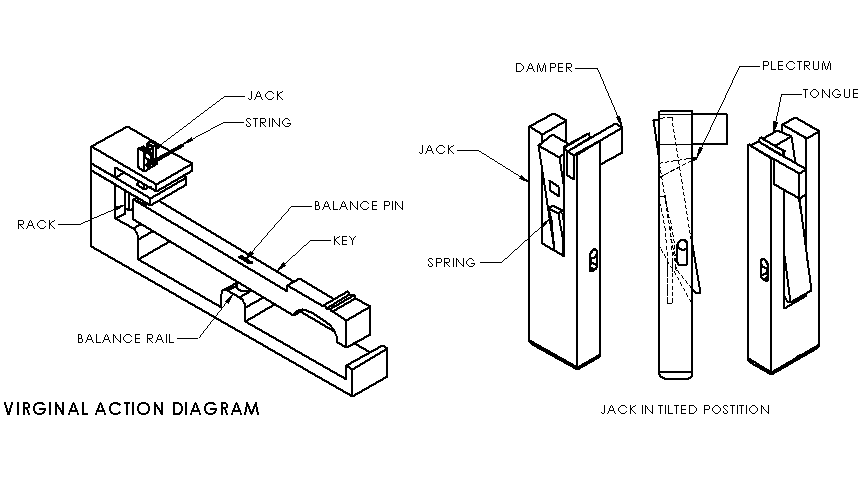
Harpsichords and virginals are plucked chordophones. Their action [see Figure D] consists of a key-lever pivoting on a balance pin. Pressing the key-lever raises a jack from its rest-position. The jack consists of a body, tongue and plectrum and damper. As the jack is raised, the slightly flexible plectum is forced upwards into and past the string, plucking it. Releasing the key-lever allows the jack to fall back to rest position, where the damper mutes the string. The string is not replucked on the return, as when the plectum falls down onto the string, the tongue is allowed to pivot backwards, allowing the plectum to pass behind the string without it sounding. This mechanism includes a damper, which allows for the keypress to control the time for which a note rings out, and also produces a significantly louder sound than tangent-struck instruments like the clavichord, but does not allow for any variation in volume.
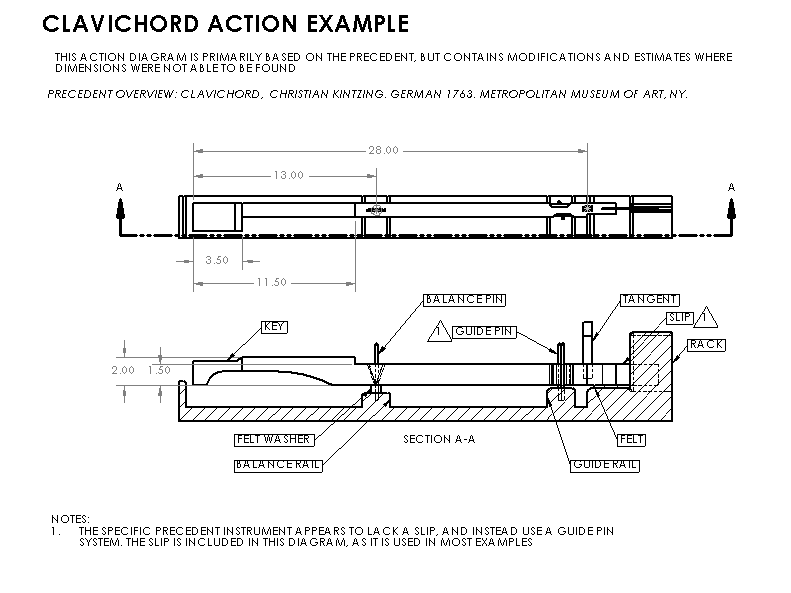
Clavichords are one type of struck chordophone. The modern piano is also struck, but is more specifically hammered, similarly to how one would strike a xylophone. The clavichord however, employs a quite unique sounding method [Figure E]. Pressing the key-lever pivots it at the balance pin, raising a metal tangent into the string. Unlike in the harpsichord, the tangent remains in direct contact with the string for the duration of the key-press. The strike point of the tangent divides the string into two lengths, one of which is the desired sounding length, and the other, called the afterlength, is muted using felt wrapping. The sound is stopped without a damper, simply by the release of the key and hence the tangent’s removal from the string. The nature of this mechanism keeps the instrument’s top volume very low in comparison to a plucked instrument, but does allow for dynamic variation, as well as for Bebung, a type of vibrato unique to the clavichord (Griffiths 2006).